Monday, February 1, 2016

Jewish Cultural Quarter

Over the past few days Connor and I have been exploring some sites and museums in the Jewish Quarter of the city, which is only a 5 minute tram ride from our apartment. In the 15th century, a lot of Jews found refuge in Amsterdam, where more religious tolerance was practiced than in the rest of Europe (especially Spain and Portugal with the Spanish Inquisition). In the 1490s Jews were given the option to convert to Catholicism, leave those countries, or to be executed. However, they weren't free in the Netherlands for very long; the ups and downs of religious freedom reached its climax with World War II and the persecution of the Jews.

*none of the pictures below are mine. I found them all on various websites because it seemed disrespectful to take them there myself

The first place we visited was the Anne Frank's house. In July of 1942, the Franks went into hiding in the concealed annex in the building her father, Otto, had worked. Eight Jewish people hid there until August 1944 when they were betrayed and brought to concentration camps. Anne and her sister Margot were transferred to Bergen Belsen concentration camp where they both died in either February or March of 1945, only weeks before the camp was liberated. She was 15 years old. Otto was the only one to survive the war and when he returned he found Anne's diary and knew it was her wish to have it published. The place where they hid remains in tact and now serves as a museum and memorial for those that were murdered in the Holocaust.

Anne Frank House
From the outside, you would think this was just your typical canal house with nothing special about it. The Nazi thought so too...

To help disguise the entrance to the secret annex, the people helping the Franks (Otto's old coworkers) put a swinging bookcase in front of it instead of a typical door.

The Franks and the four others hiding with them had three floors hidden behind the warehouse and office space. Because some of the employees didn't know they were hidden there, they had to be virtually silent all day as to not be heard. They had to  whisper and couldn't use the sinks or toilet. The windows  had to be closed and covered at all times so no one could see anything from the outside.

In her diary, Anne wrote about how decorating her sleeping space with newspaper clippings and postcards made it much more cheerful. All of the furniture has been removed from the old house, but the decorations are still there. It was heartbreaking to see Anne's diary entries about how happy those small pictures made her in such dark times. She also had a fascination with different royal families and kept track of their birthdays and interests, just like teenage girls following celebrities today.  

The Hollandshe Schouwburg was a Dutch theater, but during the Nazi occupation in 1941 it was converted to a Jewish theater where only Jewish musicians and shows could be seen exclusively by Jewish audiences. Then later it was used as a deportation center to hold thousands of Jews before being brought to concentration camps. After the war ended, most of the theater was destroyed, but the courtyard was preserved and now is a memorial. They built a wall and wrote the 7,000 family names of those who had been held there. They had a room filled with letters, photos and belongings of those people as well as moving videos of first hand accounts from the survivors. What I really enjoyed about this museum was that it focused on the people and helped show them as individuals and didn't focus on the Nazis and the horror they caused. 

The remains of the theater

Wall of the last names of the families

In 1675 one of the Portuguese Jewish communities built an impressively beautiful synagogue. Unlike most Dutch synagogues, this one, or the Esnoga, was very well preserved, as well as its 17th century elements and collections. These collections are now on display in the "Treasure Chambers" after a restoration and addition that were completed a few years ago. There was also a video that showed not only the history of the synagogue itself, but also the history of the traditions of the Jewish religion. 

Inside the synagogue

Silver collection on display, containing different ceremonial objects

Textiles and prints collection

Almost 400 year old library, the oldest Jewish library in the world.

Across the street from the synagogue is the Jewish Historical Museum which is dedicated to Jewish history and culture, not just in the Netherlands, but also throughout the world. The museum only has two permanent exhibits and regularly changing temporary ones. One focuses on Jewish culture and traditions and it showcases ceremonial objects presented in the ways they would be used in a synagogue.

I learned so much at these museums! As someone who grew up in Milton MA, a town that prides themselves on having the highest population of Irish Catholics outside of Ireland, I'm pretty ignorant when it comes to Jewish traditions. I've taken a lot of religion classes so I'm familiar with Jewish beliefs, but not customs. This was my first time in a synagogue and my first time really learning about the different facets of  their services. I've read plenty of books and seen tons of movies depicting the various parts of World War II and the Holocaust, but it was completely different seeing these places in person. After reading the Diary of Anne Frank, moving the bookcase to walk up to where the Frank family really hid in the 40s was unsettling. Waiting in the entry way of the theater where tens of thousands of people stood before being transported to concentration camps was chilling.

One of the temporary exhibits going on now at the Historical Museum is "After The War Was Over" based on a book by Leonard Freed and was the perfect way of ending our Jewish history tour. He was a Jewish New York photographer who traveled to Amsterdam in the 50s to capture what life was like for the Jews after the war had ended. Below are two of his photographs of people trying to move on after the Holocaust.


This time was very difficult for European Jews. While the majority were killed during the Holocaust, the survivors faced tough choices. They had lost family and friends, their homes and livelihoods. A lot turned away from their faith and others moved to the US, Canada, and Australia. The small Jewish population remaining struggled to rebuild. Freed was able to capture this rebuild beautifully. 

The following one of his quotes was put on the wall of the exhibit from after he had returned home to New York that I could relate to all these years later. 
"I miss Amsterdam. The marks of war were still to be seen and the first rays of the future were perking through. It was a period of transition, and it was when I discovered myself and my relationship with the world around me. It was my coming of age."

Saturday, January 30, 2016

Lauren's Birthday at the Zoo!

We've been wanting to get to the Artis Royal Zoo for a while but we finally went for Lauren's birthday!  We had a great time, there were a ton of animals to see and it wasn't crowded at all, we stayed for about 4 hours and saw maybe 30 people.  Lauren had a lot of fun climbing on top of various animals and dinosaurs!


We were really impressed with the gorilla exhibit.  The zookeepers gave talks about the animals at different times throughout the day and we were at the gorilla exhibit for a presentation there.  There were about 7 Dutch speakers and then me and Lauren and someone came talked to us about the gorillas and answered any questions we had in English.  There was also a baby gorilla that was born a week before we got there!
 
Lauren wanted to say hi to some of the animals but they ran away :(
  
 The elephants weren't scared of her though!
  
 And the turtles were pretty slow so we couldn't tell if they wanted to run away.
 There were lemurs walking around that you could go right up to.  Most of the animals were less fenced in than in American zoos, the walls were lower and sometimes moats were used instead.

 The mountain goats were one of my favorite parts of the zoo, they moved very quickly up and down the rocks and were fun to watch jump around.
Here is one of the vultures from their exhibit, some of them got to be very big!
 We got to see a bunch of giraffes too!
 
We were about to leave to zoo when we found an even larger penguin exhibit!

There was also a very nice aquarium included with admission that we were able to see.  There was another building with microscopic organisms that sounded interesting but we didn't pay extra for it at the time, we might need to go back!  It was a little bit dark inside but here are a couple pictures from the aquarium:

 We'd both definitely recommend checking out the zoo!


Saturday, January 23, 2016

Athens!

After Santorini, we flew to Athens for a few days. As someone who's always enjoyed Greek mythology and Ancient Greek history, I was beyond excited! We explored the city a bit with Emily's class and professor. Everyone was wicked friendly and welcoming and her professor, who was from Greece, was very informative and knew the way around much better than we did and definitely saved us from getting lost! We visited Lykavittos Hill, the highest point in Athens, for an amazing view of the city. I thought we would have to hike all the way to the top, but thankfully there was a train that took us up instead. It wasn't a typical train though; it went up at a 45 degree angle, like a mix between an elevator and the beginning of a roller coaster. Once we got up there, it was amazing! You could see the whole city!

You can see the Acropolis in the middle of the grassy part to the right

Professional siblings

Professional huggers

Next, we walked by the Prime Minister and the president's homes (yes I didn't know they had both, but they do). We didn't take too many pictures because there was security everywhere. It was a little intimidating to be casually walking down the street and to see men with machine guys and machetes.

There were guards called "Evzones" outside dressed with traditional kilts, caps, and clogs with pompoms. They presented an amusing contrast to the more severe officers down the street.

The streets everywhere were lined with orange trees, but we weren't sure if you could eat them or not!

The Panathenaic Stadium hosted the first modern Olympic games in 1896, but its history goes back much farther than that. It was built sometime around 500 BC and is the only stadium in the world made entirely out of marble!

Weeeee areeeee the championsssssss

The next day we visited the Acropolis!!! For anyone that might not know about it, get ready for a tonnnnn of fun facts with Lauren! The Acropolis is kind of like a small, ancient city on top of high, rocky hill overlooking the city. It is believed that it was inhabited back in the 5th century BC. Can you believe that? People lived there 500 years before Jesus was born and it's still (partially) standing! The most famous structure is definitely the Parthenon, a former temple dedicated to the goddess Athena. Since a lot of it had been severely damaged throughout the years, construction is everywhere.

Most of the statues and decorations on the buildings were based on the myths surrounding the city of Athens. Poseidon, god of the sea, and Athena, goddess of wisdom, both wanted to be the patron deity of the city so they held a contest. Whoever gave the city the best gift would win the city. Poseidon went first, and he lifted his massive trident and struck the earth, producing a sea which is now called Erekhtheis. Unfortunately the water was salty and not much use to the Athenians. Athena went next and planted a seed which grew into an olive tree. This turned out to be a much more useful gift for the Athenians because not only the olives themselves were sustenance, but also a source of oil for their lamps and for cooking their food as well as the wood from the olive tree to build their boasts and houses. Athena was named the winner and the protector of the city so most things in the Acropolis are dedicated to her.

When you first walk through the gate

Monument of Agrippa

This is where the statue of Athena Promachos used to be with the Pandroseion in the background. Every part of the massive statue was destroyed except for the marble base which you can kinda see about halfway up the picture. The bronze statue was supposed to be huge! It was built in the fourth century BC and was kept there for about a thousand years until the Romans stole her and brought her to Constantinople. Then in 1203 a mob of crusaders destroyed her. 

The Pandroseion
This was a sanctuary dedicated to one of the daughters of the first king of Athens. This is supposedly where the olive tree was planted by Athena.

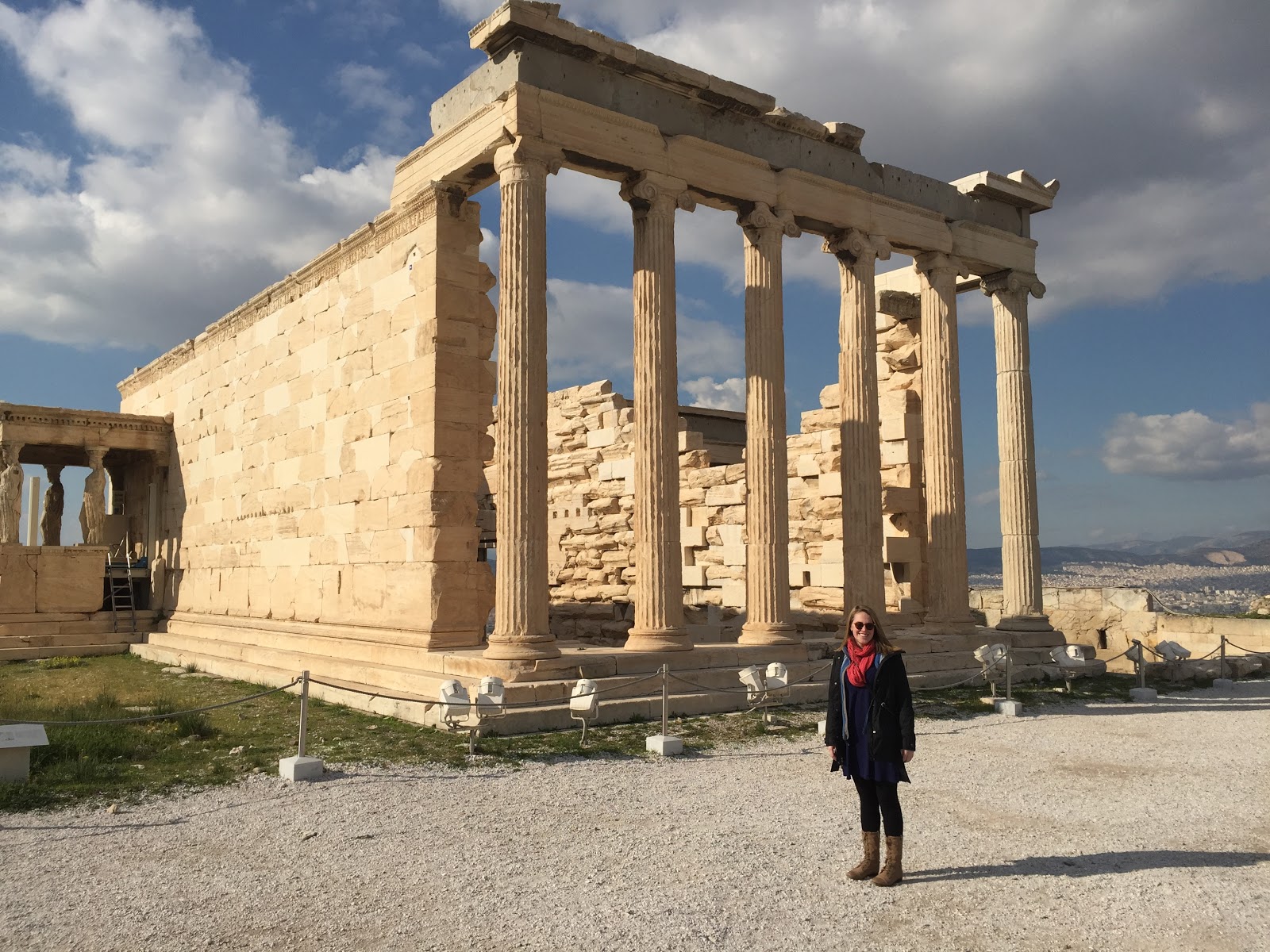
The Erechtheion
A temple dedicated to Athena and Poseidon and the supposed burial place of ancient kings.

The Old Temple of Athena
The ruins behind us were where an old temple used to be that acted as a shrine to Athena. It was built sometime around 525 BC but didn't last very long before the Persians destroyed it in 480 BC


The Parthenon!!
After the Old Temple of Athena was destroyed, the Athenians replaced it with the Parthenon as the location to worship Athena. It took from 447 BC until 432 BC to complete and was primarily used as a treasury by the Athenian Empire, not just a temple.

The Parthenon
The religious affiliation with the Parthenon shifted throughout history as Athens fell to different empires. In the 6th century AD it was a Christian church dedicated to the Virgin Mary. Then in the 1460s, after the Ottoman conquest, it became a mosque. 

Parthenon under construction
The Parthenon suffered a lot of destruction over the years. In 1687, a Venetian attack resulted in huge explosions that caused most of the damage and killed about 300 people

Temple of Athena Nike
Nike was the goddess of victory and is generally depicted with wings. Because the Athenians wanted to always have victory, they removed her wings so she couldn't fly away and erected a temple for her on the Acropolis.

The Parthenon had great views of the city!

The Theater of Dionysus
This is the oldest theater in the world and honored Dionysus, the Greek god of theater and wine. It was built in the 6th century BC and could hold 17,000 spectators. The acoustics are phenomenal, even by today's standards. We took this picture looking down on it from the Acropolis. 

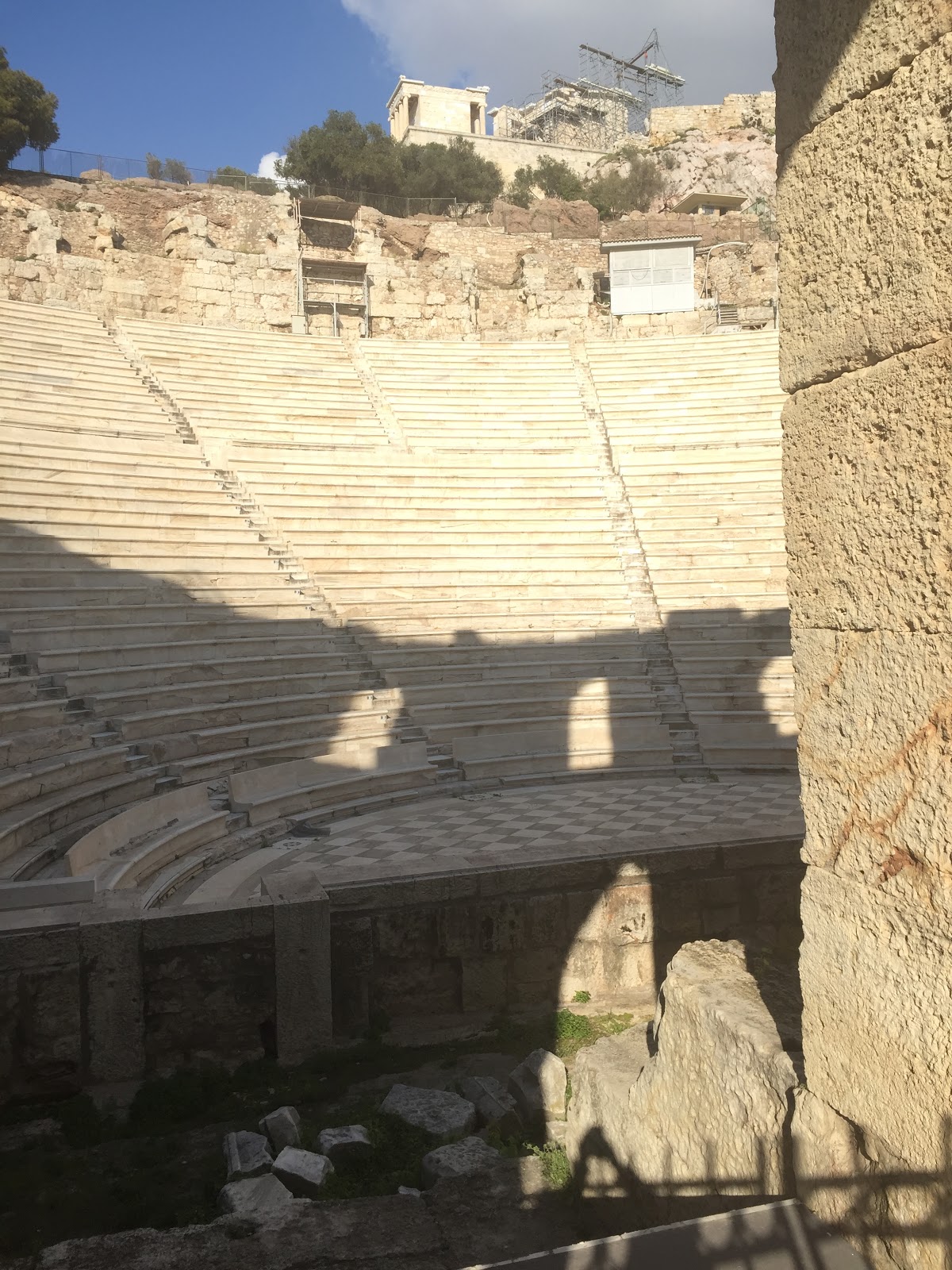
Odeon of Herodes
Another Theater next to Dionysus' is better preserved, but not as famous. It could fit 5,000 people and was built in 161 AD. It was destroyed in 267 AD by a raid by an East Germanic tribe.

Odeon of Herodes
The theaters were closed to the public but we could see the stage from outside the gate.

Temple of Zeus, Olympia
An ancient temple dedicated to the god Zeus and was built in the 5th century BC. This was closed too when we went to see it, which was too bad cause I really wanted to relive the Disney version of Hercules where do goes to talk to his dad here.

Next we visited the Acropolis museum, which has only been open for 6 years, but is used to house all of the artifacts found at the archaeological site of the Acropolis.  It has everything from the Greek Bronze Age, to the Romans, to Byzantine Greece. A lot of the old artifacts that had been uncovered were sold to the UK, but in the 1950s Greece asked for them back. The British argued that there wasn't anywhere suitable for the Greeks to display them so the plans for the new museum began. We weren't entirely sure if we could take pictures inside and I'm not much of a sneaky sneak so I only took a few.

The "Metopes" were marble panels that originally decorated the outside walls of the Parthenon in a way to tell different stories. The Metopes on the East wall of the Parthenon were situated above the entrance and depict the battle between the Olympic gods and the Giants. The North Metopes illustrate the Greeks fighting the Trojans in the Trojan War. The West Metopes show the invasion of Athens by the Amazons, which references the Persian Wars. The South Metopes present the battle between the Lapiths (people from Thessaly) and Centaurs.

The Centauromachy, or battle of the centaurs, is a favorite subject of the Athenians. It metaphorically depicts the struggle between civilization and barbarism. This metope was taken down from the Parthenon very recently after being there for 25 centuries to be preserved in the museum.

The first floor was see through so you could see parts of the excavation beneath you 

The hall showed decorative statues depicting the competition between Athena and Poseidon, 

The Caryatids
These sculptures of women were used as architectural support in the place of columns. Four and a half of them are on display at the museum (one was smashed by a Turkish cannonball) and the sixth one is in the British Museum.
 

Greece wasn't exactly what we expected. Athens especially was a surprise; it was really interesting how a city with this amazing history has ancient temples mixed in with modern technology. But unfortunately much of the city was dirty and there were homeless people everywhere. There were also people trying to sell you things and steal your money around us constantly. We couldn't sit through a single meal without someone coming up to us begging for money. And the saddest part about it was that it was predominately young kids doing this. This amazing city helped created a form of government thousands of years ago that is still partially used today, but now they're currently one of the most corrupt countries in the world. Regardless, we still had great time exploring and hanging out with Emily!