Tuesday, March 22, 2016

1916 Easter Rising Walking Tour

Connor and I got really lucky with our timing visiting Dublin because, not only was it close to Saint Patrick's Day, but also because it's the one hundred year anniversary of the 1916 Easter Rising rebellion that led to Irish Independence. We did a walking tour through the city to visit some of the important sites of the rebellion. It was awesome! I learned so much, but what was especially nice was that there were only 4 other people on the tour so it was on a much more personal level and we got to know the guide and the other people better.

The walking tour started at City Hall. During the Easter Rising rebellion, there was a small number of Irish troops on the top floor of City Hall, but the English were given false information and tricked into thinking there were a lot more. They tried sneaking up on the Irish and ended up surprising each other and the English soldiers ended up firing on each other.

the outside didn't look too impressive, but inside it was beautiful! Along the top, the different panels depict important events in Irish history, such as the Celtic and Viking arrivals. It also showed Lambert Simnel, who was a 10 year old boy that resembled the heir to the English throne, named the new king by supporters who didn't want Henry VII to be king. He got caught, but Henry forgave him and gave him a job working in his kitchens!

The city saying in English translates to "obedient citizens, happy city". The figure on the left is "law" holding a sword and an olive branch and then the figure on the right is "justice" holding the scales of justice. The shamrocks are supposed to represent the holy trinity.

A battle broke out right in the center of city hall and you can see one of the bullet holes next to the knee in this statue.


The next place on the tour was Dublin Castle, which was originally built as a defensive fortification, but later evolved into a royal residence.

This gate was the location of the first casualty of the rebellion.  


This is the statue of justice, but there are a few problems with her. For one, she's facing the wrong way; she has her back to the city. She also isn't blindfolded, like she should be. One of her scales is also under her arm and other isn't so when it rains, one of them fills with water while the other remains dry. It doesn't really send a good message if Justice's scales are tipped unevenly!

Through the blue door is where the Anglo-Irish Treaty was signed in 1921 ending the War of Independence

Records Tower next to the chapel 


The Bank of Ireland used to be where Parliament was located

Statue of Daniel O'Connell, who was a political leader in the early 1800s. His statue is filled with bullet holes from the battle

The old House of Commons, which as its windows boarded up to prevent break ins

The General Post Office, which the Irish used as headquarters for the rebellion

A plaque used as a memorial for The O'Rahilly, an Irish nationalist killed retreating back to the GPO. As he lay dying in a doorway, he wrote a letter to his wife and it's printed here to commemorate his sacrifice.

There is a lot of controversy because different groups want to use the site of the rebellion for different purposes. They started construction to turn it into a shopping center, but people got really upset and they were forced to put construction on hold. Now there are some people who want to turn it into a museum and others who want to leave it just as it was. Here are some signs protesting.

The last stop on our tour was the Garden of Remembrance which is dedicated to the memory of "all those who gave their lives in the cause of Irish Freedom". 

In Celtic tradition, when the war is over, they symbolically break their weapons and throw them into the water so this is illustrated here.

This statue is at the end of the garden. It depicts the Children of Lir, who were children that were turned into swans and spent 900 years in different bodies of water.


This tour was fun fact city! We loved it, especially because we got to see the city in a completely different light!

Guiness and Jameson!

If you visit Dublin, especially the week leading up to Saint Patrick's Day, it's pretty much illegal not to go to the Guiness Storehouse and the Jameson Distillery, so obviously Connor and I didn't want to get arrested so we went on both tours.

Guiness is really cool because it's shaped like a giant pint glass so the tour takes you up the different levels, each of which focus on different stages of the process. The self guided tour starts with the different ingredients, and then goes into the brewing process. It has another level dedicated to their different marketing and advertising campaigns over the years. You then take a class on how to pour the perfect pint. Finally you end on the top floor, called the Gravity Bar that is all glass and shows a 360 degree view of the city. At first, we were psyched because there wasn't a long line to get in, but unfortunately we didn't realize that meant that everyone was already inside. It actually kind of detracted from the experience because there were so many people we couldn't see anything. The bar was  PACKED we couldn't even get an inch of table space. It was still fun and I would recommend going, but it was pretty frustrating constantly having people in the way.


high quality H2O

Hops that can grow up to 15 feet


We're experts now! They gave us certificates and everything!


view from the Gravity Bar

Jameson was a lot less crowded and more enjoyable. I had never been to a distillery before so I learned a lot! Unfortunately, the whiskey isn't made at this location anymore, but it was still cool to see how the process worked.


The different colors in the barrels show how long the whiskey has been aging in there. Starting with the bottom left, it's been in there for a year, the middle one has been in there three years, bottom right for five years, top left for twelve and top left for fifteen ( I think!)

At the end of the tour, we had a tasting of  different whiskeys.  On the right is Scottish Whiskey (Johnnie Walker Black), the middle is Irish Whiskey (Jameson) and the left is American whiskey (Jack Daniels)


I think Connor's favorite part of doing these tours is getting me to finally drink beer and whiskey and not, as he calls them, fruity girly drinks!

Cliffs of Moher, Wild Atlantic Way and Galway!

Connor and I went on a fantastic day trip to the west coast of Ireland for our 4 year anniversary! During the 2 and a half hour bus ride, our awesome guide and driver told us really interesting stories about the history of Ireland, as well as about the places we were passing. I really enjoyed all the stories about fairies; more than half of the Irish people still believe in them! There are these ring forts that are believed to be bushes where the fairies live and there are over 45,000 of them throughout the country that have existed for thousands of years that no one will touch out of fear of disturbing the fairies. They even spent $3 million building a highway to avoid a fairy tree! Some people also believe that if someone you know is sick, you rip off a piece clothes and tie it to the tree and then in the night the fairies will come and heal them. We passed a few of these trees covered in strips of clothes on the drive and they were really beautiful.

We really lucked out that the rain held off when we arrived at the cliffs, but they were wicked foggy; one second everything was clear and the next you could barely see 2 feet in front of yourself! We also learned that a few people a year die taking selfies on the edge of the cliffs so we were careful not to get too close! At it's highest point, the cliffs are 700 above the Atlantic Ocean so it would realllly suck to fall...


O'Brien Tower marks the highest point of the cliffs. It was built by Cornelius O'Brien who was a member of Parliament that built the tower for tourists


Where they filmed a scene in Harry Potter and the Half Blood Prince!!! This is where Dumbledore and Harry go to find the cave where the locket is hidden

These shields (O'Brien and Sullivan) they had on display were obviously meant for Aunt Rosie!

We passed some cool places  driving west and then along the Wild Atlantic Way, which has the Atlantic Ocean on the left and the "burren" on the right. JRR Tolkien and CS Lewis both lived along the Atlantic Way and you can definitely see how it influenced their writing.

We also saw some of the consequences of the Great Famine, which lasted from 1845-1852 and resulted in nearly a million people dying and another million people leaving Ireland. A new program was developed for building roads, which eventually culminated in the much despised 'famine walls' built up throughout the country, but particularly in the hills and mountains of the west of Ireland. These walls were built solely to provide work to peasants in return for food. More often than not these stone walls provided no economic or infrastructural benefit, but were built anyway. Thousands of people died working on these walls.
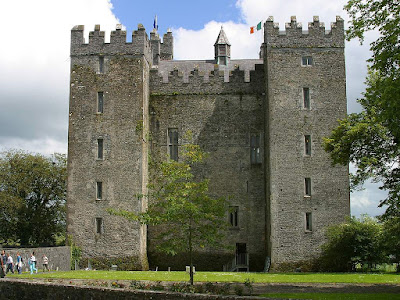
Bunratty Castle (stole this from Google!)

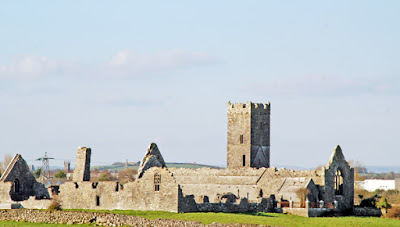
Clare Abbey


Dunguaire Castle


We passed a few homes that had roofs like this. They have to be changed every 4-7 years because they get so damaged by the rain.

Next we went to Galway, which was such a colorful fun city! One of the most interesting things we learned about on the walking tour of the surrounding area were the Tribes of Galway, which were 14 merchant families who dominated the political, commercial, and social life of  Galway from the 13th until the 19th centuries. You could still really feel their presence with plaques and huge houses throughout the city.

The symbol of Claddagh outside the shop to the right was made by a man who lived nearby to make an engagement ring for his finance. The heart represents love, the two hands friendship, and the crown loyalty. 

This bar is an original medieval structure, dating back over 800 years old. It was once the home of the Mayor of Galway, until it was seized by Col. Peter Stubbers in 1653. Stubbers is responsible for the beheading of King Charles I of England in 1649.

Smaller windows meant the family that owned it didn't have as much money. Since stained glass was very expensive, the bigger the window, the wealthier the family.

fun bar where we grabbed a bite!

We had an awesome guide and bus driver whose stories made the tour so much better! While we were in Galway, we stopped at the home of the Lynch family, which had some really interesting history. Outside, there is a statue of a monkey holding a baby, which is a tribute to a pet monkey that saved their baby (and only son and heir) from it while it was burning. The other side of the building is also famous, but for a more...negative reason. James Lynch was mayor in 1493 when his only son killed a young Spanish visitor in their home. When the city heard about it, they were furious and demanded justice. James Lynch didn't know what to do because he loved his son, but the people were restless and formed a mob demanding justice. Finally James gave in and hung his son outside a window of their home. This is where we got the term, "lynch mob." Not-so-fun facts!

Connor and I had a great time! We were so lucky to be able to see so much of this beautiful country!